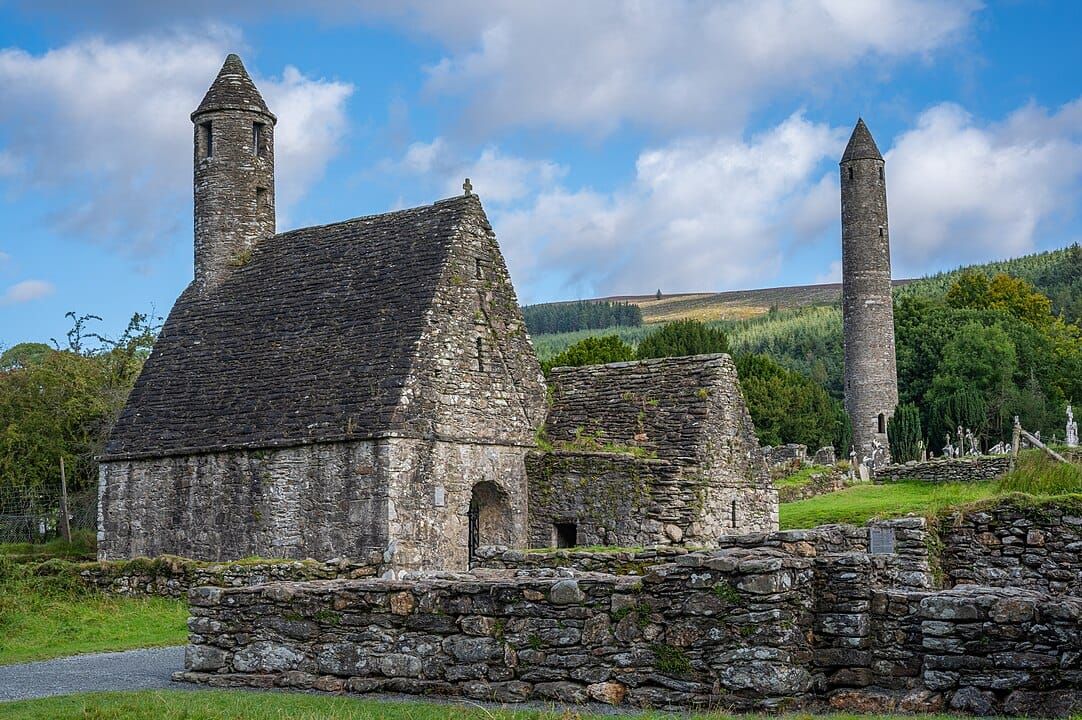
Leinster holds some of Ireland’s most important heritage. In the Boyne Valley in Meath, Brú na Bóinne is a UNESCO World Heritage Site older than the pyramids at Giza. Below are the monuments across the province that are set up to visit, county by county, with the official visitor information for each.
Visitable historic sites by county
| County | Sites to visit |
|---|---|
| Dublin | 9 |
| Meath | 7 |
| Wexford | 6 |
| Kilkenny | 5 |
| Wicklow | 4 |
| Kildare | 2 |
| Louth | 2 |
| Carlow | 2 |
| Laois | 2 |
| Offaly | 2 |
| Westmeath | 2 |
| Longford | 2 |
Historic sites in Dublin
Dublin has 4,224 recorded archaeological monuments. These are the ones set up to visit:
St. Audoens Church, Dublin City. Church, Dublin South City. Sited in the heart of the walled medieval city, St Audoen’s Church is the only remaining medieval parish church in Dublin. It is dedicated to St Ouen the 7th century bishop of Rouen and patron saint of Normandy.
Lusk. Church, Lusk. Lusk Heritage Centre comprises of a 9th century round tower, a medieval belfry and a 19th century church. They form a unit, although they were built over a period of almost a thousand years.
St. Mary’s Abbey Abbey, Dublin City. Religious House, Cistercian Monks, Dublin North City. St. Mary’s Abbey is one of Dublin’s best kept secrets. It was once the wealthiest Cistercian Abbey in Ireland. Today only two rooms remain - the Chapter House and the Slype.
Rathfarnham Castle. House, Fortified House, Rathfarnham. The original castle at Rathfarnham dates back to the Elizabethan period and was built for Archbishop Adam Loftus, an ambitious Yorkshire clergyman, who came to Ireland as chaplain to the Lord Deputy and quickly rose to become Archbishop of Dublin, Lord Chancellor of Ireland and was closely involved in the establishment of Trinity College.
Monkstown Castle. Castle, Tower House, Monkstown Castlefarm. Today Monkstown Castle is situated in the suburbs of Dublin. In medieval times the castle here was the centre of a large farm owned by the Cistercian monks of St. Mary’s Abbey in the city of Dublin.
Kilmashogue Megalithic Tomb. Megalithic Tomb, Wedge Tomb, Kilmashogue. Today the wedge tomb at Kilmashogue is located in forestry, but originally it would have been situated on an open mountain side overlooking the lowlands now occupied by Dublin city. The site was excavated in 1953.
Kilmainham Gaol. Prison, Kilmainham. One of the largest unoccupied gaols in Europe, covering some of the most heroic and tragic events in Ireland’s emergence as a modern nation from 1780s to the 1920s.
Casino Marino, Dublin City. Building, Marino. The Casino was designed by Sir William Chambers as a pleasure house for James Caulfeild, 1st Earl of Charlemont.
Tully Church. Church, Laughanstown. The old church of Tully near Cabinteely is situated on a low hill overlooking much of south county Dublin and has fine views of the Dublin Mountains.
More to see in Dublin: things to do in Dublin →
Historic sites in Kildare
Kildare has 3,086 recorded archaeological monuments. These are the ones set up to visit:
Old Kilcullen Monastic Site, Co. Kildare. Ecclesiastical Site, Oldkilcullen. The ancient church of Old Kilcullen is situated on a high hill with panoramic views over the surrounding countryside.
Maynooth Castle. Castle, Anglo-Norman Masonry Castle, Maynooth. This great stone castle was founded in the early 13th century and became the principal residence of the Kildare branch of the Geraldines.
More to see in Kildare: things to do in Kildare →
Historic sites in Wicklow
Wicklow has 3,089 recorded archaeological monuments. These are the ones set up to visit:
Baltinglass Abbey. Religious House, Cistercian Monks, Baltinglass East. Baltinglass Abbey stands on the banks of the River Slaney on the outskirts of the small town of Baltinglass.
Aghowle Church. Church, Aghowle Lower (Shillelagh By.). The ancient church at Aghowle is associated with St Finnian (who died in 549), and he is supposed to have established a church at Aghowle before founding his more famous site at Clonard, Co. Meath.
Glendalough. Graveyard, Sevenchurches Or Camaderry. This early Christian ecclesiastical settlement was founded by St. Kevin in the 6th century.
The Dwyer McAllister Cottage. House, 18Th/19Th Century, Derrynamuck. The cottage nestles in the shade of Kaedeen mountain at the top of a grassy lane off the Donard to Rathdangan road in Co. Wicklow.
More to see in Wicklow: things to do in Wicklow →
Historic sites in Meath
Meath has 4,921 recorded archaeological monuments. These are the ones set up to visit:
Bective Abbey. Religious House, Cistercian Monks, Bective. Bective Abbey overlooking the legendary River Boyne is the oldest Cistercian foundation in Meath and the second oldest in Ireland.
Loughcrew Megalithic Cemetery. Megalithic Tomb, Passage Tomb, Corstown (Fore By.). The Loughcrew Cairns, also known as the Hills of the Witch, are a group of Neolithic passage tombs dating to 3000 BC.
Knowth Passage Tomb Cemetery. Megalithic Tomb, Passage Tomb, Knowth. The great passage tomb cemetery of Knowth, built over 5,000 years ago during the middle of the Neolithic period (around 3200 BC), is one of a number of monuments which, together with the nearby passage tombs of Newgrange and Dowth, form part of ‘Brú na Bóinne’ UNESCO World Heritage Site.
Newgrange Passage Tomb. Megalithic Tomb, Passage Tomb, Newgrange. The great passage tomb mound of Newgrange built over 5,000 years ago during the middle of the Neolithic period (around 3200 BC) is one of a number of monuments which, together with the nearby passage tombs of Knowth and Dowth, form part of the ‘Brú na Bóinne’ UNESCO World Heritage Site.
Trim Castle. Castle, Anglo-Norman Masonry Castle, Manorland (1St Division). Trim Castle, the largest Anglo-Norman castle in Ireland, was constructed over a thirty-year period by Hugh de Lacy and his son Walter.
Skreen Church. Church, Skreen. Standing tall and proud on the summit of Skreen Hill, overlooking the more famous Hill of Tara, is the site of an ancient church associated with St Columba.
Hill of Tara. Graveyard, Castleboy (Skreen By., Tara Par.). Though best known as the seat of the High Kings of Ireland, the Hill of Tara has been an important site since the late Stone Age when a passage-tomb was constructed there.
More to see in Meath: things to do in Meath →
Historic sites in Louth
Louth has 2,461 recorded archaeological monuments. These are the ones set up to visit:
Proleek Megalithic Tombs. Megalithic Tomb, Portal Tomb, Proleek. Located to the south-west of the Cooley Mountains near the lower slopes of Black Mountain, Proleek portal tomb is one of the best-known and most iconic megalithic tombs in Ireland.
Mellifont Abbey. Religious House, Cistercian Monks, Mellifont. The first Cistercian monastery in Ireland founded in 1142 by St Malachy of Armagh, its most unusual feature is the octagonal Lavabo c. 1200.
More to see in Louth: things to do in Louth →
Historic sites in Wexford
Wexford has 3,978 recorded archaeological monuments. These are the ones set up to visit:
Ferns Castle. Castle, Anglo-Norman Masonry Castle, Castleland (Scarawalsh By.). It is believed that in the middle of the 12th century a castle built by Diarmait MacMurrough stood on the site of the present stone castle.
Ferns Cathedral and High Crosses. Cathedral, Ferns Upper. The earliest cathedral was built here at the beginning of the 13th century by John St John, Bishop of Ferns between 1223-1243.
Ferns Abbey. Religious House, Augustinian Canons, Ferns Demesne. In 1162, a new Augustinian monastery was founded at Ferns by Diarmait MacMurrough. Only parts of the church and the vaulted chancel survive today.
St. Peter’s Church, Ferns. Church, Ferns Upper. This curious church has a number of early features; however it appears that it was actually constructed towards the end of the 16th century.
Ballyhack Castle. Castle, Tower House, Ballyhack. Ballyhack Castle is located on a steep slope in a commanding position overlooking Waterford estuary. The castle, a large tower house, is thought to have been built c. 1450 by the Knights Hospitallers of St.
Tintern Abbey. Religious House, Cistercian Monks, Tintern. A Cistercian abbey, founded c. 1200 by William, the Earl Marshall, and named after Tintern in Wales. The remains consist of nave, chancel, tower, chapel and cloister.
More to see in Wexford: things to do in Wexford →
Historic sites in Kilkenny
Kilkenny has 5,555 recorded archaeological monuments. These are the ones set up to visit:
Dunmore Cave. Cave, Mohil. History and geology blend at Dunmore Cave to give an interesting and unique situation.
Kells Priory. Religious House, Augustinian Canons, Rathduff (Madden). Approaching Kells Priory today, with its walls and castellated towers, it looks more like a fortified settlement than a religious house.
Jerpoint Abbey. Religious House, Cistercian Monks, Jerpointabbey. An outstanding Cistercian abbey founded in the second half of the 12th century. The church with its Romanesque details dates from this period.
St. Mary’s Church, Gowran. Church, Gowran. This collegiate church, was built in the late 13th century on the site of an earlier monastery. It was served by a “college” - clerics who lived in a community but who did not submit to the rule of a monastery.
Kilkenny Castle, Kilkenny City. Castle, Anglo-Norman Masonry Castle, Dukesmeadows (Shillelogher By., St. Patrick’S Par.). A 12th century castle remodelled in Victorian times and set in extensive parklands which was the principal seat of the Butler family, Marquesses and Dukes of Ormonde.
More to see in Kilkenny: things to do in Kilkenny →
Historic sites in Carlow
Carlow has 1,940 recorded archaeological monuments. These are the ones set up to visit:
Browneshill Megalithic Tomb. Megalithic Tomb, Portal Tomb, Kernanstown. Known as the ‘Browneshill dolmen’, because it is sited on a hill on which sits the former estate house of the Browne family, the remains of this megalithic tomb are well-preserved and the chamber faces down slope to the east.
Saint Mullin’s Ecclesiastical Site. Church, St. Mullin’S. A beautiful monastery nestled between the waters of the Barrow and the Aughavaud was founded here in the 7th-century by Moling Luachra, known today as St. Mullin.
More to see in Carlow: things to do in Carlow →
Historic sites in Laois
Laois has 2,216 recorded archaeological monuments. These are the ones set up to visit:
Timahoe Round Tower. Round Tower, Timahoe. Timahoe Round Tower, a monastery was founded here by St Mochua mac Lónáin in the early 7 th century.
Dunamase Castle. Castle, Anglo-Norman Masonry Castle, Aghnahily,Ballycarroll (Maryborough East By.),Park Or Dunamase. The Rock of Dunamase is a spectacular natural feature visible in the landscape of Co. Laois. It takes its name from the Irish Dún Másc, meaning the ‘Fort of Masc’.
More to see in Laois: things to do in Laois →
Historic sites in Offaly
Offaly has 4,879 recorded archaeological monuments. These are the ones set up to visit:
Clonmacnoise. Graveyard, Clonmacnoise. An Early Christian site founded by St. Ciarán in the mid-6th century on the eastern bank of the River Shannon.
Sierkieran Monastic Site. Graveyard, Churchland. The name Seir Kieran derives from Saighir Chiaráin, meaning ‘the fountain of Ciarán’.
More to see in Offaly: things to do in Offaly →
Historic sites in Westmeath
Westmeath has 4,540 recorded archaeological monuments. These are the ones set up to visit:
Fore. Religious House, Benedictine Monks, Fore. Fore is situated in a marshy valley and takes its name from the Irish word fobhair, meaning a spring or a well. The earliest church at Fore was founded by St. Féichín around AD 630. St.
Hill of Uisneach. Barrow, Pond Barrow, Kellybrook. A range of archaeological monuments on The Hill of Uisneach including ‘Lough Lugh’ marks the mythological and sacred centre of prehistoric Ireland, in modern day County Westmeath.
More to see in Westmeath: things to do in Westmeath →
Historic sites in Longford
Longford has 2,659 recorded archaeological monuments. These are the ones set up to visit:
Corlea Trackway. Road, Class 1 Togher, Cloonbreany,Corlea. The centre interprets an Iron Age bog road that was built in the year 148 B.C. across the boglands of Longford, close to the River Shannon.
Granard Motte and Bailey Castle. Castle, Motte And Bailey, Granard,Moatfield. An earth and timber castle constructed around 1199 by Richard de Tuite as part of the Anglo-Norman conquest of Longford.
More to see in Longford: things to do in Longford →
Source: National Monuments Service (data.gov.ie), CC BY 4.0.